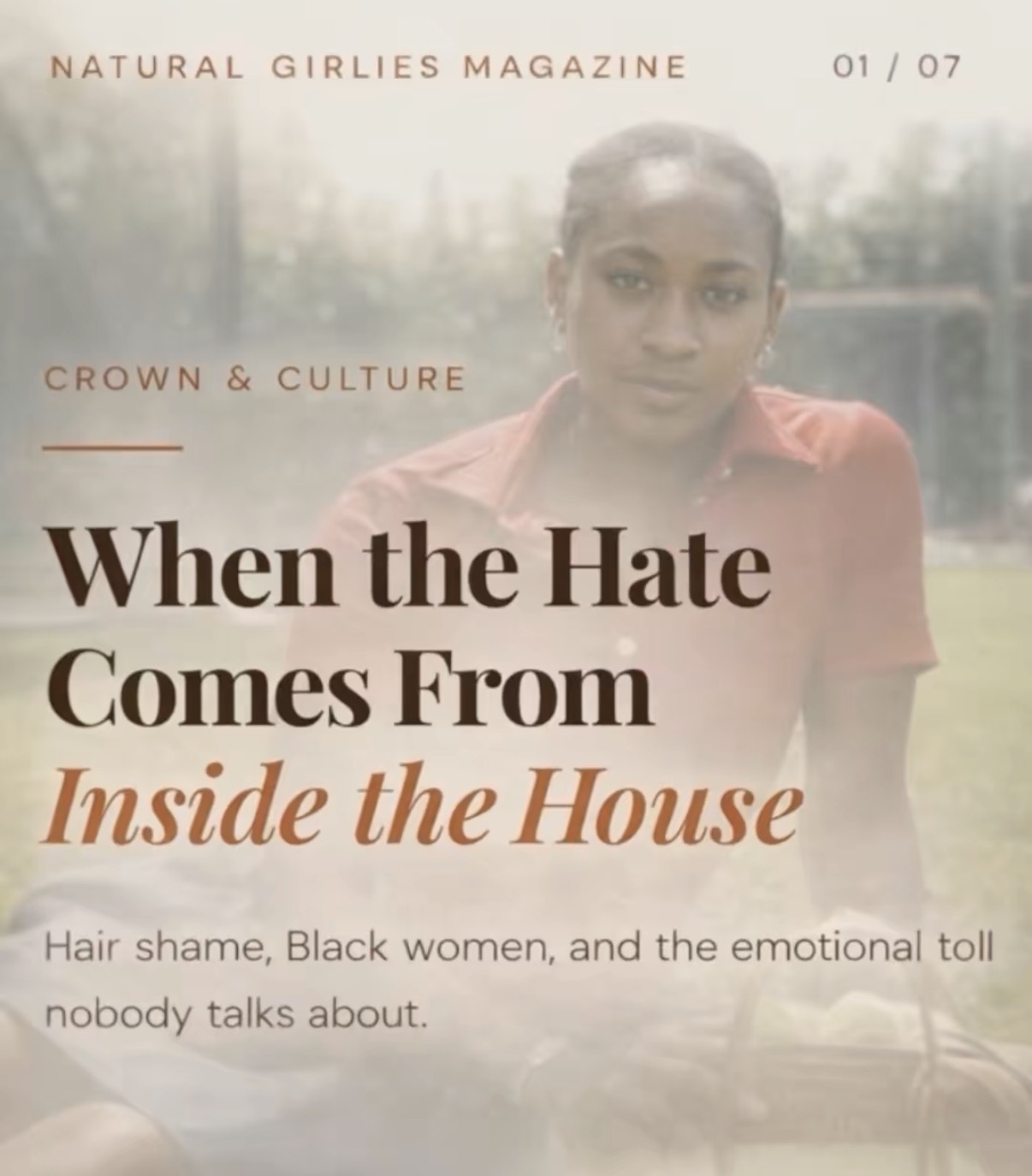
Coco Gauff walked into a Miu Miu campaign with her 4C hair in a simple bun, no makeup, fully herself — and the internet had an entire breakdown about it. But the part that stings the most wasn't the strangers. It's never just the strangers.
Around the same time Coco's photos were going viral, another video was quietly circulating on TikTok. A Black woman sitting in a chair, freshly installed weave, looking beautiful — and her own friend standing behind her, picking apart everything about it.
The length. The texture. The edges. Laughing in a way that wasn't really laughing. And the woman in the chair got smaller and smaller with every comment.
These two stories are not separate. They are the same story, playing out at different volumes.
The Wound That Lives At Home
There is something uniquely devastating about hair criticism that comes from inside your own community. From your own friends. Your aunties. Your mama.
Because at least when a stranger says something cruel, you can dismiss them. You can say they don't know you, they don't love you, they don't get it. But when it's someone who does? The wound goes somewhere deeper.
It confirms the fear you've been carrying since the first time someone handed you a relaxer kit: that your hair, in its natural state, is not enough.
Black women's hair has never just been hair. It has been a site of survival, resistance, identity, and yes — trauma. For generations, we were told that straight was professional, that coily was unkempt, that our natural texture was something to be managed, tamed, fixed.
And those messages didn't just come from white institutions. They came from within. They got passed down at the kitchen table, whispered at family reunions, said out loud at slumber parties by girls who were just repeating what they'd already absorbed.
The wound goes somewhere deeper when it comes from someone who loves you. It confirms the fear you've been carrying since the first time someone handed you a relaxer kit.
We have to be honest about this. The natural hair movement did something radical — it gave Black women permission to stop chemically altering their hair and to love what grew from their scalp. But it didn't fully dismantle the hierarchy. It just created a new one.
Now there are conversations about whose natural hair is “done enough,” whose twist-out is presentable, whose protective style looks “cheap.” The policing didn't stop. It just moved inside.
What It Actually Does to You
When someone critiques your hair — especially someone you love — it rarely stays about the hair. It triggers something much older. Questions about whether you belong. Whether you're pretty enough. Whether you're Black enough, polished enough, put-together enough.
Women have described crying in parking lots after family gatherings. Canceling plans because they didn't have the energy to deal with comments. Avoiding certain people during the in-between stages of their hair journey because the remarks became too much to carry.
Coco Gauff said something important when she responded to the backlash: she had felt beautiful until the comments started. Then she cried. That is what this does. It reaches into a moment of confidence and quietly dismantles it.
And if it can happen to a two-time Grand Slam champion in a global fashion campaign, it is happening to regular women every single day — in ways that accumulate, layer by layer, into something heavier than most of us know how to name.
Why We Do It to Each Other
This is the conversation people want to skip. But it's the one that actually matters.
Intra-community hair criticism often isn't about hate. It's about fear, and projection, and unprocessed shame. When someone looks at a woman in her natural hair and immediately reaches for criticism, they are usually telling you something about their own relationship with their hair.
Their own internalized messages about what is acceptable, what is beautiful, what is safe. The friend who laughed at the weave? She has probably been laughed at too. She just hasn't done the work of tracing where that impulse came from.
That doesn't make it okay. But it does make it understandable. And understanding it is the first step toward breaking the cycle — because we cannot keep passing this wound down and calling it honesty.
We cannot keep passing this wound down and calling it honesty.
What Healing Actually Looks Like
It starts with naming what happened. Not brushing it off. Not saying “she didn't mean it like that.” If a comment about your hair made you feel small, that is real information — and it deserves your attention, not your dismissal.
It means building a relationship with your hair that belongs to you. Not your aunt's opinion of it. Not the comment section's opinion of it. Not even the natural hair community's rubric for what counts as “thriving.”
Your hair, your journey, your terms. Start by learning how to read your hair's traits and test your porosity so the routines you choose actually fit the crown you're growing.
That is not an easy thing to build in a world that has spent centuries telling Black women their natural texture is a problem to be solved. But it is the most important work you can do. Give yourself the patience to track your hair growth over months — not days — and let the slow proof of your own crown answer back to every voice that ever told you it wasn't enough.
And it means being willing to look at yourself honestly — at the ways you might have repeated this pattern, consciously or not. The offhand comment you made about someone's edges. The question you asked about why she didn't do something “more” with her hair.
The comparison you made between two women's styles with one of them not knowing they were being measured. We have all participated in this. The invitation is to stop.
To the Woman in That Chair
You looked beautiful. Whatever they said, whatever they laughed at — you looked beautiful, and your hair was never the problem. The problem was that someone used your hair as a place to put something that was never about you.
And to Coco — thank you for not apologizing. Thank you for saying out loud that your 4C hair was good enough for Miu Miu, which means it is good enough, full stop. That sentence will live in someone's head on a hard day and remind her that she doesn't need permission.
None of us do.
Your hair journey deserves a safe space
Hair Wellness Lab Was Built for This
A platform designed by a Black woman, for women who have been told their hair is too much — or not enough. Track your hair health, understand your unique needs, and find your community.
Explore Hair Wellness Lab →Frequently Asked Questions About 4C Hair and Hair Confidence
What is 4C hair, and why is it so often misunderstood?
4C is the tightest curl pattern in the natural hair typing system, with strands that coil into a Z-shape and very little visible curl definition. Because the curl is so tight, 4C hair shrinks dramatically when wet and can look very different from its actual length. It is not “difficult” hair — it just behaves differently from looser textures, and most mainstream hair advice was never written with it in mind. Once you learn its rules, 4C hair is one of the most versatile textures in the world.
Why does criticism of Black women's hair feel so personal?
For Black women, hair has never been just hair. It carries generations of survival, resistance, and identity, and it has been used as a measuring stick for beauty, professionalism, and worth. When someone criticizes a Black woman's hair — especially someone from inside her own community — it doesn't just touch a styling choice. It touches a much older wound about belonging and being enough.
How can I start healing from hair shame?
Start by naming it. If a comment made you feel small, treat that as information instead of brushing it off. Build a relationship with your hair that belongs to you, not to anyone else's opinion of it. Learn your texture, your porosity, and the routines that actually fit your crown. Healing from hair shame is slow work, but every act of self-defined care chips away at it.
Is the natural hair community supportive or judgmental?
The natural hair community has done radical, beautiful work to give Black women permission to wear their hair as it grows. It is also still a community of human beings, which means new hierarchies have emerged about whose natural hair is “done enough” or “presentable.” Both things can be true. The healthiest version of the community holds space for every stage — twist-outs, weaves, braids, wash-and-gos, transitioning hair, and everything in between.
How do I build hair confidence as a Black woman?
Confidence rarely comes from perfecting your hair. It comes from understanding it. Learn your curl pattern, your porosity, and the way moisture moves through your strands. Track your growth in months instead of days. Surround yourself with images and people that reflect the full range of Black hair beauty. And give yourself permission to wear your crown the way you want to wear it — without explanation, without apology.