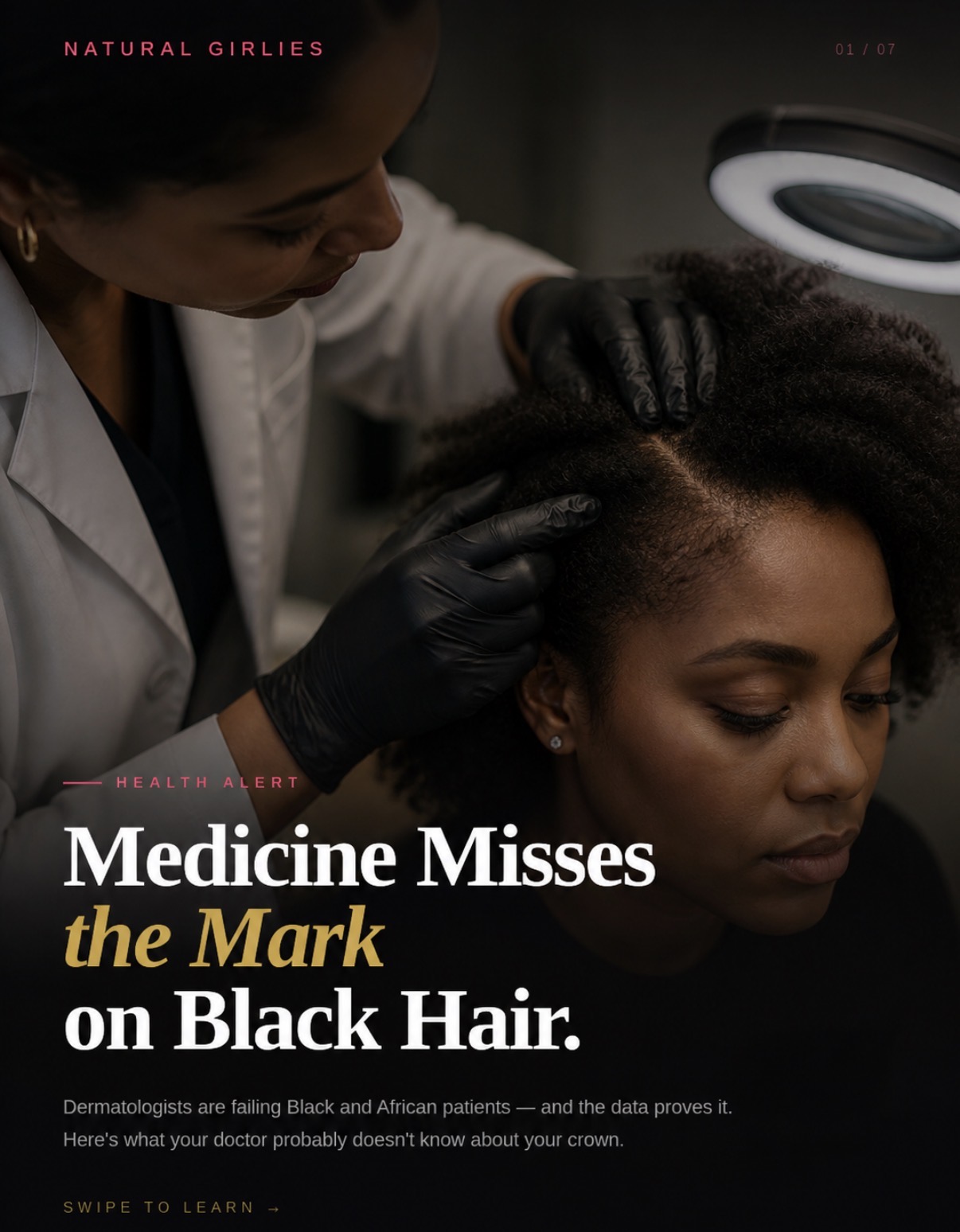
There is a particular silence that settles over a Black woman in a dermatologist's office when her concern is met with a shrug. The appointment ends. The prescription, if there is one, rarely fits. And the question that follows her home is the one she has been trained not to say out loud — did anyone in this room actually see me?
What looks like an isolated bad visit is almost never isolated. It is a pattern, and it has a paper trail. Across clinics, hospital systems, and academic medical centers, Black women describe the same arc: a thinning edge brushed off as styling damage, a tender patch dismissed as stress, a slow and quiet retreat of the hairline that no one names until the loss is permanent.
This is not a story about one rude doctor. It is a story about an entire field that was built without us in mind, and the women who are paying the price for that omission with their crowns, their confidence, and their trust.
The Reality Check
Recent research on Black women's experiences in dermatology is sobering. Roughly forty-seven percent — nearly one in two — report feeling dismissed, misunderstood, or unheard during dermatology visits. That number is not an outlier. It is a baseline. It tells us that dismissal is not the exception in this specialty; for Black patients, it is something close to standard.
The reasons are structural, not personal. Cultural competency — the ability of a clinician to understand a patient's background, hair practices, and lived context — is still treated as an elective skill rather than a clinical requirement. A provider who cannot tell the difference between a healthy protective style and a harmful one will read every braid the same way. A provider who has never been taught how 4C hair grows, sheds, or responds to inflammation will mistake normal for abnormal, and abnormal for normal.
The downstream effect is measurable. Black patients are more likely to receive delayed diagnoses for scalp and skin conditions, more likely to be undertreated when a diagnosis finally arrives, and more likely to leave the clinic with care plans that were not designed for the hair on their head. The gap is not just in attention. It is in evidence, training, and follow-through.
The Knowledge Gap
Step inside a dermatology textbook and the absence becomes visible. Across the most widely used educational resources in the field, only around three percent of clinical images depict dark skin. Three percent. An entire spectrum of melanin-rich complexions — the spectrum that includes the majority of Black, African, Afro-Caribbean, and Afro-Latina women — is being trained on a sliver of representation.
The classroom hours tell the same story. Many dermatology residency programs offer fewer than four hours of dedicated education on conditions in skin of color across the entire curriculum. Four hours, in a specialty whose accuracy depends entirely on what the eye recognizes. A trainee can graduate, take their boards, and open a private practice having never seen, in any meaningful detail, what eczema, lupus, or scarring alopecia looks like on a patient who looks like you.
Conditions also present differently on darker skin. Redness can read as deep purple, brown, or simply slightly darker than the surrounding tone. Inflammation can hide rather than announce itself. Scarring can blend into pigmentation patterns that an untrained eye will read as cosmetic rather than clinical. When the visual cues a doctor was taught to look for never appear in the form they were taught to expect, the diagnosis they reach is rarely the right one.
An entire field has been trained on a sliver of representation — and the women who fall outside it are the ones being told their concerns are not real.
The Misdiagnosis Problem
Nowhere is this gap more visible than in hair loss. The two conditions most often confused in Black women — traction alopecia and androgenetic alopecia — sit at opposite ends of the same misunderstanding. Traction alopecia is mechanical: the slow toll of tight braids, sewn-in installs, repeated tension on a fragile hairline. Androgenetic alopecia is hormonal and genetic, a different beast entirely. Treating one as the other does not just delay healing. It invites permanent loss.
Then there is central centrifugal cicatricial alopecia — CCCA — a scarring form of hair loss that disproportionately affects Black women and remains one of the most underdiagnosed conditions in dermatology. CCCA tends to begin at the crown and radiate outward, often without dramatic shedding, often without the classic redness a textbook would teach. Without a biopsy, without an experienced clinician, it is mistaken for breakage, for over-styling, for stress. By the time it is correctly named, scar tissue has already replaced active follicles, and the window for slowing the disease has narrowed considerably.
Protective styling is the third casualty. A clinician unfamiliar with the rhythm of Black hair care will see braids, locs, or a wig install and reach immediately for the styling explanation, regardless of what the scalp is actually doing. Healthy protective styling is a centuries-old practice that allows hair to rest, retain length, and avoid daily manipulation. Reduced to a one-line warning in a chart note, it becomes the reason a real medical condition gets overlooked.
The cost of these mistakes is measured in years. Years between the first concern and the right diagnosis. Years between an early-stage scalp inflammation and a treatment that could have preserved the follicle. For a condition like CCCA, those years are not recoverable.
The Human Impact
There is a particular kind of grief that comes with watching your hair change and being told nothing is wrong. It is not loud. It is the quiet of standing in front of a mirror, parting the same section, counting the same bare patch, and deciding once again not to bring it up at the next appointment because last time the doctor barely looked.
For Black women, hair has never been a small thing. It is identity, lineage, ritual, and language. Losing it — slowly, without explanation, without a clinician willing to investigate — is a layered loss. It touches self-image. It touches the way a woman moves through her day, what she covers, what she avoids, what photographs she stops taking. The medical literature calls this psychosocial impact. The women who live it call it something heavier.
Layered on top of that is the trust gap. Each dismissed visit teaches a Black patient that the clinic is not always a place where she will be believed. Some women stop going. Some keep going and stop bringing their hair up. Some search for a culturally competent provider for years before finding one. None of these are personal failings. They are rational responses to a system that has not earned the patience it expects.
Shifting the Power
The honest answer to a problem this systemic is not to ask Black women to fix it on their own. The system has work to do. But while that work moves slowly, there is real, recoverable power in walking into your next appointment more informed than the last.
Better questions change the conversation. Instead of asking is something wrong with my hair, ask what condition would explain a thinning that starts at the crown and moves outward. Instead of accepting it's probably just breakage, ask whether a biopsy would help rule out CCCA, lichen planopilaris, or another scarring alopecia. Specific language gets specific answers. It signals to a clinician that you are not arriving without context, and it shifts the visit from one that can be dismissed to one that requires real engagement.
Knowing the names of conditions matters. CCCA. Frontal fibrosing alopecia. Traction alopecia. Seborrheic dermatitis. Lichen planopilaris. These are not insider terms — they are the vocabulary your provider works in, and using them yourself narrows the room for guesswork.
Tracking changes over time matters even more. A pattern documented in photographs, dates, and notes is harder to wave off than a pattern described from memory. Capture the parting line at the same angle each month. Note when symptoms begin, what makes them worse, what soothes them. Bring that record into the appointment. It is no longer your word against a calendar.
And when something feels wrong and the answers feel rushed, advocate for the biopsy. A small scalp punch biopsy is the gold standard for diagnosing scarring alopecias, and it is the difference between guessing and knowing. You are entitled to ask for one. You are entitled to a second opinion if the first one does not look closely enough.
Better questions change the conversation. Specific language gets specific answers.
What a Solution Ecosystem Looks Like
Hair Wellness Lab was built for the gap this article describes. Not as a replacement for a doctor, but as the layer of crown literacy and documentation that has been missing between Black women and the clinics they walk into.
Crown Health awareness begins with understanding what your scalp and hair are actually doing — your texture, your porosity, your shedding rhythms, the conditions that look like styling damage but aren't. CrownPrint™ is built around these questions, with language designed for Black hair, by a Black woman, in five focused minutes.
Crown tracking gives you the documentation a clinician will take seriously. Use the Hair Growth Tracker and scalp logging tools to capture month-over-month change, compare photos taken at the same angle, and arrive at your appointment with a record instead of a recollection.
And the Crown Care Directory exists because who you see matters as much as that you see someone. The directory is being built to surface culturally competent dermatologists, trichologists, and scalp specialists who have demonstrated real fluency with Black hair and scarring alopecias — so the next appointment is not another roll of the dice.
Together, these tools form what we call a solution ecosystem: literacy, documentation, and access. None of them solve the system on their own. All of them tilt the next visit in your favor.
Reclaiming the Authority
The deepest harm in being dismissed is not the missed diagnosis. It is the slow erosion of your sense that you have the standing to ask. That erosion is what a system relies on. It is also what we are choosing to refuse.
You are not overreacting. You are not being difficult. You are reading your own scalp, your own shedding, your own hairline with the closest possible attention, and that attention is clinical data — even when no one in the room treats it that way yet.
Walk in informed. Walk in with names, with photographs, with the question that needs answering. Ask for the biopsy. Ask for the second opinion. Bring your record. Bring your standards. Your crown deserves informed care — and informed care begins the moment you decide that uncertain is no longer an acceptable answer.
Built for what medicine has missed
Hair Wellness Lab Was Built for This
A platform designed by a Black woman, for women whose scalp concerns have been dismissed for too long. Track your crown, learn the language, and walk into your next appointment fully prepared.
Explore Hair Wellness Lab →Frequently Asked Questions About Black Hair, Dermatology, and Scalp Health
Why are Black women so often misdiagnosed in dermatology?
The gap is structural. Most dermatology textbooks contain only about three percent of images showing dark skin, and many residency programs dedicate fewer than four hours to skin-of-color education. Conditions also present differently on melanin-rich skin — redness can read as purple or brown, inflammation can hide, and scarring can blend into pigmentation patterns. When clinicians are trained on a narrow visual reference, they reach narrow conclusions, and Black patients are the ones who absorb the cost.
What is CCCA and why is it underdiagnosed?
Central centrifugal cicatricial alopecia (CCCA) is a scarring form of hair loss that disproportionately affects Black women. It typically begins at the crown and radiates outward, often without dramatic shedding or obvious redness — which is why it is so frequently mistaken for breakage, over-styling, or stress. Diagnosis requires a scalp biopsy and an experienced clinician. Without early recognition, scar tissue replaces active follicles, and the loss becomes permanent.
How do I tell the difference between traction alopecia and other types of hair loss?
Traction alopecia is mechanical — caused by repeated tension from tight braids, weaves, ponytails, or sew-in installs, usually concentrated along the hairline and temples. Androgenetic alopecia is hormonal and genetic, often presenting as diffuse thinning across the crown. Scarring alopecias like CCCA tend to start at the crown and spread outward. Pattern, location, and timeline matter — and a clinician who knows Black hair will ask about each one. When a single explanation is offered without those questions, ask for more.
Should I ask for a scalp biopsy?
If you are losing hair in a pattern that is not clearly explained by styling or genetics, yes. A small scalp punch biopsy is the gold standard for diagnosing scarring alopecias and ruling out conditions that mimic them. It is a quick, in-office procedure. You are entitled to request one, and you are entitled to a second opinion if your concerns are not being taken seriously.
How can I find a culturally competent dermatologist?
Look for clinicians who have published, trained, or specialized in skin of color, hair of color, or scarring alopecias. Ask, before booking, how often the practice sees Black patients with hair loss and what their approach to CCCA and traction alopecia involves. The Crown Care Directory is being built to surface providers who have demonstrated this fluency, so the search becomes shorter and the next appointment becomes safer.